Monsters vs Virus
Welcome to Camp Macaroon!
The most popular summer holiday spot for monsters!
More details:
https://fd.ort.edu.uy/novedades/monstruos-vs-virus-videojuego-que-busca-ganarle-al-covid
Document:
Click to view and download:
Fact sheet:
-
Educational health game for children.
-
In partnership with Hospital Britanico and Universidad ORT Uruguay.
-
Genre: Time management.
-
Languages: English and Spanish
-
Ages: 8 to 12
-
Platform: Mobile
-
Team: 7 members.
-
Development: 3 months
Monsters vs Virus is a children's educational time management game in both English and Spanish for mobile platforms meant to teach players from 8 to 12 years old how to protect themselves against COVID-19.
My role:
-
Game writer
-
Narrative designer
About the Game:
The game is centered on a monster summer camp where the sudden appearance of a rapidly growing virus threatens the safety of all those who are in close contact.
It is up to the player to:
-
Delay the spread of the disease by following security protocols.
-
Respect maximum capacity in each location, use protective shields and identify those infected to be isolated.
-
Look after the campers' wellbeing, while also making sure they have an enjoyable summer experience.

Goal: Educate children on the importance of taking care of one's health, not only for their own personal benefit but for everyone else around them as well.
Children will be able to associate events and consequences inside the game with the new reality that we are currently experiencing amid Covid-19 and generate positive changes regarding the importance of respecting health protocols.
Design Process:
My narrative design process began by understanding the game’s educational goals and player experience.
I worked closely with the team to define the narrative’s role within the mechanics of a mobile game designed around limited dialogue and short playthrough sessions.
To address this, I focused on concise pieces of writing, using short lines of dialogue, UI text, and environmental cues to convey narrative information quickly and clearly.
From there, I developed character profiles that fit the game’s worldbuilding, reinforced its theme, and helped present learning objectives in an engaging way rather than an instructional one.
As this was an fantasy educational game aimed at children, all characters were designed as:
-
Classical monsters with cute artstyle.
-
Children of similar age to the target audience
Once the contstraints were decided, I developed each character’s personality, goals, and quirks, creating individual character sheets to ensure they felt distinct and believable.

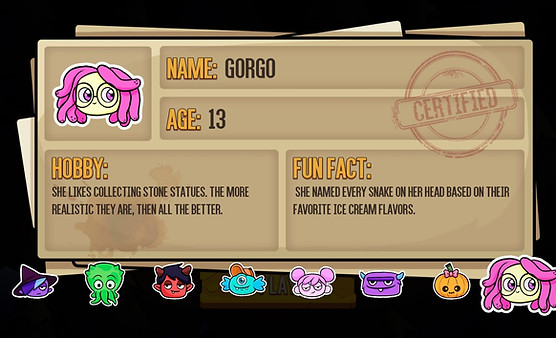
This process also included the creation of the narrator character, who serves as the leader of the camp and functions as an in-game tutorial. Particular attention was given to establishing a voice that aligned with the game’s tone and supported player guidance without feeling intrusive.
Once the narrative foundations were established, I moved into dialogue writing, ensuring that the few pieces of in-game text clearly communicated emotion and context. This phase involved drafting and iterating on dialogue and UI text to support immersion while keeping language accessible and age-appropriate.


The project also required narrative consistency across English and Spanish, which presented an additional challenge in preserving tone, humour, and character voice between languages.
I worked on both versions of the game, adapting texts rather than translating it literally to ensure that meaning and emotional impact remained consistent and easily understandable.
Working this way helped me maintain a cohesive narrative experience for all players, regardless of language.
Documentation was also a key part of my workflow. Through character sheets and narrative documents I communicated story intent with the team while also serving as a reference during production.
Throughout this project, working closely with designers, artists, and developers helped me ensure narrative intent was understood and always reflected across gameplay and visuals in a meaningful way.
Spaces of interactive storytelling are very much my passion, and through collaboration, iteration, and clear communication, I aim to contribute narrative work that strengthens both gameplay and player experience.
This project represents my ongoing goal of growing as a narrative designer while working across teams, genres and creative challenges.